
GOING BACHARACH: THE DEEP CUTS
Part 1: "Wives and Lovers"—Burt, Hal, and Jack.
“Husbands Lovers Always Should Be”
I spent much of the last year working with my very wonderful collaborators, the brilliant director David Zippel, producer Jack Lewin, and musical director Adrian Galante, putting together a revue titled Going Bacharach: The Songs of an Icon. It’s my pleasure to report that this production has just opened Off-Broadway at the Marjorie S.Deane Little Theater at 10 West 64th Street.—to excellent reviews. In the course of working on this show, I have become entrenched in the marvelous music of this most versatile and distinguished of American songwriters. My next few Substacks are going to be devoted to oddball nooks and crannies in the Bacharach canon; these are “the deep cuts,” as we kids say.
As we wrote a few months ago, when we discussed Ella Fitzgerald’s relationship to the Bacharach songbook (that post is here), someone needs to write a history of so-called “movie exploitation” songs. These are numbers that were written to promote a film, but are not actually heard in the film itself. They enjoy a long tradition, going back to the silent era, when there were no actual soundtracks but there were in-person orchestras (or at least organs and pianos) to accompany the on-screen action. Most exploitation songs were composed for films that didn’t otherwise have songs or singing, although there are exceptions: ”When You Wish Upon a Star”—not an exploitation song—was famously actually sung in Pinocchio (1940); however, the song “Monstro the Whale” was recorded by Kay Kyser and his Orchestra, and performed live on the radio, but is not heard in Pinocchio itself.
Burt Bacharach got his start writing movie exploitation songs, beginning with “The Desperate Hours,” recorded by Eileen Rodgers as a single for Columbia Records. (That song gets endlessly confused with a 1960 song recorded by Mel Tormé but not written by Bacharach, but that’s another Substack.)
Bacharach’s most successful exploitation song was “Wives and Lovers,” written as a tie-in with the 1963 Paramount comedy of the same name. There’s a long tradition in American cultural history for a song to become more famous than the film that introduced it. In fact, that’s often the case: who remembers that “It’s Only a Paper Moon” was first heard in Take a Chance (1933) or “Star Eyes” in I Dood It (1943). Wives and Lovers represents a more extreme example of a major motion picture becoming eclipsed by a song that wasn’t even in it.
In 1964, “Wives and Lovers,” with its well-crafted—but not entirely sincere—lyric by Hal David (more about those shortly) was the biggest hit thus far for the young singer Jack Jones. It is also an early example of a hit song written in the form of a jazz waltz. (Another would be “What the World Needs Now Is Love” by Burt and Hal from 1965.) “Wives” was a major breakthrough for Bacharach and David, not to mention Jack, earning the three of them a Grammy Award for Song of the Year.
At first, “Wives” was widely “covered,” with recordings in 1964 by Wayne Newton and Frank Sinatra—both of whom sang it in 4/4, and therein hangs a tale—and it gradually went on to become a true jazz standard. (Others who sang it in 1964 include Vic Damone, Andy Williams, and everyone’s favorite centenarian, Dick Van Dyke.) Ella Fitzgerald famously sang “W&L” on her 1966 album Whisper Not and included it throughout her 1966-’67 tours with Duke Ellington, as heard in Ella at Juan-les-Pins and The Stockholm Concert. (And yes, Ella sang it as written in ¾.)
It should be stressed that Hal David’s lyrics for “Wives and Lovers” were written to reflect the situation in a 1963 marital comedy—the viewpoint expressed therein does not necessarily reflect the views of David or Bacharach, or Jones. As Jack continued to sing the song, he was increasingly embarrassed by the words, and, a few years later, he decided to do something about it. When I first met Jack, around 1990, we talked about “Wives and Lovers” and he mentioned that he had written what today we would call “A Feminist Response” to the original lyric, although he didn’t use that term at the time.
Jack sang some of the words for me, and I wanted to hear the whole thing, but somehow I never got around to asking. I don’t even know if he would have remembered those gag lyrics all those decades later. After Jack died at 86 in 2024, it seemed unlikely we would ever hear this alternate parody lyric.
Then, to my surprise, the response lyric turned up in a video shared with me by the Dublin-based collector and scholar Jason McGuire. This is a 1967 syndicated television special produced by Hal Stein, filmed in Chicago, titled Jack Jones & Vikki Carr: A Very Special Occasion. The show starts with ten minutes or so of Jack walking around, taking in the sights of the Windy City, which is sort of similar to the “San Francisco” sequence in Tony Bennett’s Singer Special of 1966. There follow about 15 minutes of the fine singer and ‘60s pop star Vikki Carr, shown in what seems like a string of music videos. We see Ms. Carr lip-synching to pre-recorded tracks of her singing standards, in a variety of different costumes. They also do a duet on “The Honeymoon Is Over” (from I Do! I Do!) filmed in the same fashion.
The gem of the special is roughly 20 minutes of Jack live at the Empire Room in the Palmer House, which is no less legendary in Chicago than the Empire Room at the Waldorf Astoria was for the rest of the known universe.
Jack sings only seven songs, but they’re all winners, and most of them are uptempo and hard swinging. He starts with the standard “I Only Have Eyes for You” and then a more contemporary standard, “I Will Wait for You”—for some reason here, he’s willing to spend a “thousand dollars” rather than a “thousand summers.”
Then there are two jazz waltzes. The first is “The Donkey Serenade,” the famous Rudy Friml number associated with his father, the famous tenor (and movie star) Allan Jones. In Jones family lore, as Jack relates, Allan recorded his biggest-ever hit and signature song, “The Donkey Serenade” (in the MGM operetta film The Firefly) on the same day that his son was born, January 14, 1938. “And that,” says the young Jones in Chicago, “is why he named me Jack.”
(below, the 1967 Chicago concert video, at the start of “Wives and Lovers,” first the “straight” version.)
Then we come to “Wives and Lovers.” He sings the lyrics as written, and as heard on his hit single:
Hey, little girl
Comb your hair, fix your make-up
Soon he will open the door
Don’t think because
There’s a ring on your finger|
You needn’t try any more|
For wives should always be lovers, too
Run to his arms the moment he comes home to you
I’m warning you
Day after day
There are girls at the office
And men will always be men
Don’t send him off
With your hair still in curlers
You may not see him again
For wives should always be lovers, too
Run to his arms the moment he comes home to you
He’s almost here
Hey, little girl
Better wear something pretty
Something you’d wear to go to the city
And dim all the lights
Pour the wine, start the music
Time to get ready for love
The chorus is finished, but there’s more! Jack then addresses the crowd as follows:
Thank you. I think that one of the reasons that I sold a few records of that song is because the men bought the records. See, they bought it, and they took it home and they played it for their wives, the wives listened carefully…. and then I got letters! [pause] I got letters from women who were upset. They didn’t agree with the lyrics. They felt that they were untrue and they weren’t fair. I could see how they feel. One lady was particularly upset about the whole thing and she decided that something must be done immediately, so she sat down and wrote her own lyrics, which naturally take up the women’s point of view. So she sent it to me in protest. And I thought it was particularly interesting. So, if I may, I’d like to read it. I’d like to read it anyway, it goes like this.… Dear Abby…”
(Jack is so sincere in this introduction that some listeners—and now, some readers—might actually think he wasn’t kidding, some anonymous wife really did write this lyric and send them to him. But no, these are Jack’s own words.)
Hey, little boy, cap your teeth, get a hairpiece,
You’re no Rock Hudson I’m told,
Don’t think because you work hard at the office,
You can come home and just fold.
For lovers always husbands should be,
I run to your arms the moment you come home to me,
And what do I see?
In through the door comes a Vic Tanny dropout
Singing the 9-to-5 blues
Practicing how to inform his employer
What kind of mouthwash to use.
For lovers always husbands should be,
But you’re not home long before you’re turning on TV.
It’s Batman or me!
There’s more to life than just washing the dishes
I’m full of wishes,
I wish that you’d come out to play,
Hey little boy, pour the wine, start the music,
Time to get ready for love.
Time to get ready - hey, wake up Eddie!
Time to get ready for me!
After the two versions of “Wives and Lovers”—maybe the special lyrics should be called “Lovers and Wives”—of course, in my life, the song is more pertinently titled “Wives and Lawyers”—Jack sings another of his big hits, “The Impossible Dream.” Then he comes to the only slow-ish ballad in this mini-set, “Brother, Where Are You?” which he sings beautifully, after a thoughtful and heartfelt introduction for writer Oscar Brown, Jr. He then concludes with “Along the Way,” not to be confused with “Somewhere Along the Way,” but rather a song that Funny Girl songwriters Jule Styne and Bob Merrill penned for an epically bizarre TV special from 1965 titled The Dangerous Christmas of Red Riding Hood, which also deserves a substack.
I was particularly overjoyed to find the video of Jack Jones doing his special “feminist response” lyric to “Wives and Lovers.” A year or so ago, when we started work on the project that became Going Bacharach, I showed the lyrics to Jack Lewin and Adrian Galante and they agreed that they should go into the show; they concurred that it was a fun bit, and also that the original lyrics to the song needed to be presented in a proper context.
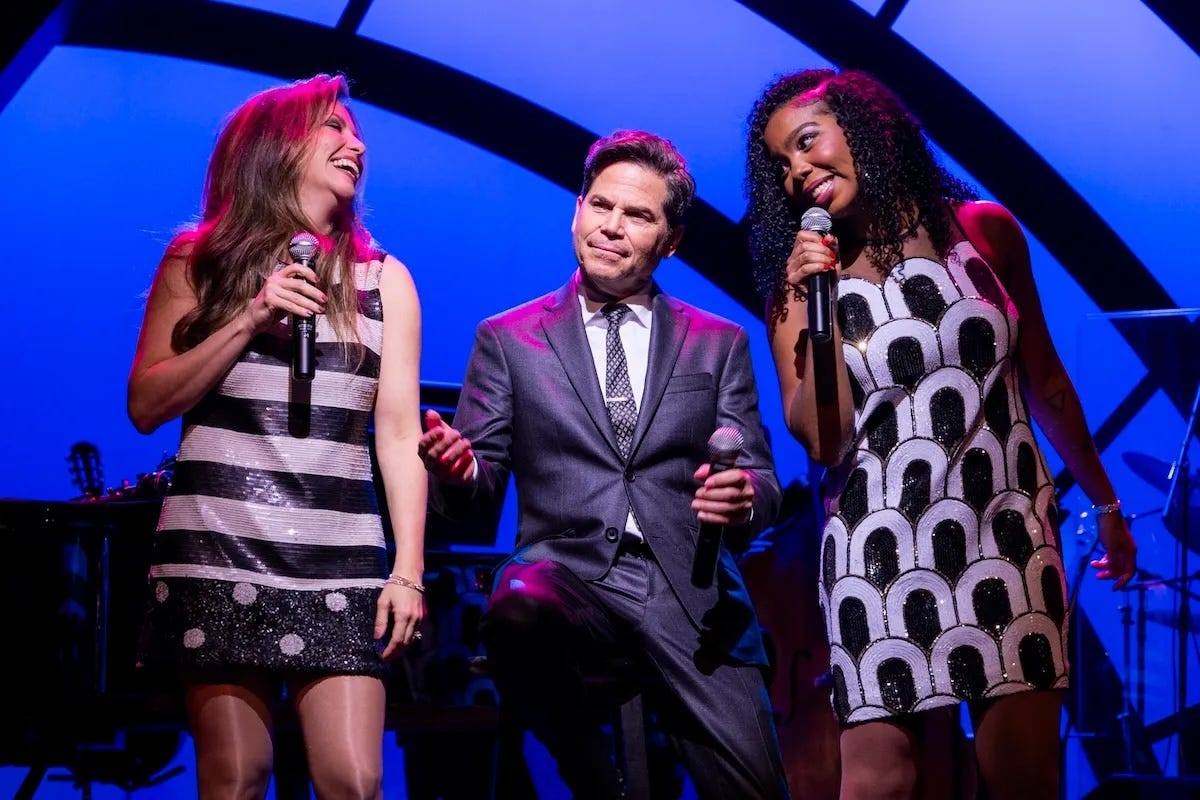
Adrian and David came up with a perfect bit of staging, which involves all three of our singers, Hilary Kole, John Pagano, and Ta-Tynisa Wilson. The sequence starts with Hilary coming out and singing the 1963 original text. She then addresses the audience, admitting that these are “not the most enlightened lyrics, even by the standards of 60 years ago!” and then adds, “The story goes that Jack received so many letters from women all over the country complaining the lyrics were misogynistic, that he decided to write a new set of words from the women’s point of view.” She sings a slightly altered version of Jack’s text, with “George Clooney” switched in for “Rock Hudson” and “The Dodgers” instead of “Batman.”
There has been at least one contemporary female singer—the marvelous Cécile McLorin Salvant—who makes a point to sing the 1963 lyrics as written, without an update. Somehow, she turns the song into a kind of feminist counter-statement, in much the same way that the late Betty Carter did for the Neal Hefti-Bobby Troup “Girl Talk.” But for the purposes of our show, and in memory of the great Jack Jones, who was a great friend as well as a great vocalist, this better serves our purposes. And the audience does get a major chuckle out of it. Sometimes you need a laugh along the way.
Two Bacharach-centric episodes of SING! SING! SING!
Going Bacharach, Part 2
(SSS #181 2025-01-10)
download: <or> play online: + Playlist
Going Bacharach Pt 1: Bacharach Around the Clock
(SSS #023 2022-12-03)
download: <or> play online: + Playlist
Coming Very Soon—Your Next Favorite Substack: “The Adventures of Bill Boggs.” Yes! (Watch this space for details!)
(Very special thanks to Elizabeth Zimmer, Rob Lester, & Dan Fortune for their expert proofing, hey!) Special Thanks again to Daniel Weinstein, Jordan Taylor, & Rob Waldman.
Sing! Sing! Sing! : My tagline is, “Celebrating the great jazz—and jazz-adjacent—singers, as well as the composers, lyricists, arrangers, soloists, and sidemen, who help to make them great.”
A production of KSDS heard Saturdays at 10:00 AM Pacific; 1:00 PM Eastern.
To listen to KSDS via the internet (current and recent shows are available for streaming) click here. Here is the running list of recent shows.
The whole series is also listenable on Podbean.com; click here.
THIS JUST IN! THE OFFICIAL ALL-NEW
“SING! SING! SING!” T-SHIRT!

“IT’S TRUE!
IT’S TRUE!
IT’S ALL TRUE!”
SING! SING! SING!
What A WONDERFUL New Year!
(SSS #180 2025-01-03)
download: <or> play online: + Playlist:
New Year’s Eve with Mr. Booze (Drinking Songs)
(SSS #179 2025-12-27)
download: <or> play online: + Playlist
Alt-Christmas (By Request)
(SSS #178 2025-12-20)
download: <or> play online: +Playlist:
The Sammy Davis Jr Centennial - Sammy By Request
(SSS #177 2025-12-13)
download: <or> play online: + Playlist
Sinatra sings Burke & Van Heusen REDUX
(FS 2025 01 2025-12-01)
Download: <or> play online:
The Paul Williams Jazz & Traditional Pop Songbook
(SSS #176 2025-11-29)
Download <or> : play online: + Playlist:
Kinds of Blues Pt 1 - Can Blue Men Sing the Whites?
(SSS #175 2025-11-21)
download: <or> play online:
Psychedelic Vaudeville with Trav S D
(SSS #174 2025-11-15)
Download: <or> play online: + Playlist:
“Just the Contrafacts, Ma’am”
(SSS #173 2025-11-08)
download: <or> play online: + Playlist:
Finding NEMO (“’Tis Autumn - The Henry Nemo Songbook”)
(SSS #172 2025-11-01)
download: <or> play online: + Playlist
QUINN LEMLEY interviews WILL FRIEDWALD “Secrets of the Stage”
download: <or> play online: <or> video
ALAN BERGMAN at 97: A Birthday Present!
(SSS #011 2022-09-10)
download: <or> play online:
With Seth McFarlane: “Lush Life: The Lost Sinatra Arrangements”
(SSS #154 2025-06-28)
download: <or> play online:
SLOUCHING TOWARDS BIRDLAND is a Substack newsletter by Will Friedwald. The best way to support my work is with a paid subscription, for which I am asking either $5 a month or $50 per year. Thank you for considering. (Thanks as always to Arlen Schumer for special graphics.) Word up, peace out, go forth and sin no more! (And always remember: “A man is born, but he’s no good no how, without a song.”)
Note to friends: a lot of you respond to my Substack posts here directly to me via eMail. It’s actually a lot more beneficial to me if you go to the Substack web page and put your responses down as a “comment.” This helps me “drive traffic” and all that other social media stuff. If you look a tiny bit down from this text, you will see three buttons, one of which is “comment.” Just hit that one, hey. Thanks!
Slouching Towards Birdland (Will Friedwald's Substack) is a reader-supported publication. To receive new posts and support my work, consider becoming a free or paid subscriber.
ooh ooh! Yes, I will do that! Something I just realized is that Burt Bacharach actually wrote a song in 1959 that uses a very similar melody, "Make Room For the Joy," sung by Jack Jones (way before "Wives and Lovers") in the movie JUKE BOX RHYTHM. Here, play this track and let me know whether or not you think it sounds like "Girl Talk" :
https://youtu.be/hL4QBo5ZLGY
Will, it's Christina. What an interesting post. I remember being puzzled by W & L when it was a hit. All the grown women I knew had jobs and went to work, not sitting around the house, anyway. It reflects a real "Mad Men" era point of view.
Congrats on your show and great press! I'll tell Gene B. He'll be happy for you, too!