
Duke Ellington’s 1943 masterpiece BLACK, BROWN AND BEIGE: “A Church of his Own.”
A vintage 1988 story in honor of a new performance of this brilliant work by the Jazz at Lincoln Center Orchestra this week in Rose Hall.

In March of 1988, the American Jazz Orchestra, which had been formed by Gary Giddins and Roberta Swann two years earlier, presented a rare performance of Duke Ellington’s elusive masterpiece, the 1943 Black, Brown and Beige.
I was very pleased to be asked to write a review of that concert for The Village Voice. I was 26 at the time, and I have never been able to see that story again since The Voice’s online archive doesn’t go back that far. Finally, my great friend (and fellow Substacker and fellow KSDS online host) Loren Schoenberg tracked down the text on an obscure website somewhere. So here is a story that I haven’t seen for over 38 years.
To me, one of the major aspects of the 1988 AJO performance is that it’s the only one I have experienced where Ellington’s spoken narration was performed—recited by no less than the great Bobby Short—and there also was a vocal (on “The Blues”) by Michelle Hendricks. (Incidentally, Maurice Peress, who conducted the AJO for this show, also made two entirely different recordings of BB&B, but although the 1992 version featured Joe Williams singing “The Blues,” neither one included the spoken narration.)
I am delighted to share this vintage 1988 story because this Thursday and Friday (July 23 and 24), Jazz at Lincoln Center is presenting a special summer concert featuring this rarely-performed work, with the JALC Orchestra conducted by Chris Crenshaw and and a special guest vocal by the marvelous Ekep Nkwelle. In all the years I’ve been following this music, this is only the third time I’ve been able to hear this remarkable work played live, so I am truly looking forward to it. For info, click here!
Masterworks of orchestral jazz, even when they have been definitively recorded by their creators, deserve to be performed in concert. But beyond merely keeping charts alive, orchestras can restore history. Nothing drove this point home more than the American Jazz Orchestra’s concert at Cooper Union last Thursday, an all-1940s Duke Ellington program that climaxed with his longest, fullest composition, Black, Brown, and Beige. Just playing this piece correctly -- or any seminal score by Ellington, Herman, Basie, Evans, Carter, J. J. Johnson -- would justify the existence of the AJO, but this time they’ve transcended even that need by finishing what the master architect left undone. Now in its third year, the AJO has topped its eight previous programs by restoring one of the greatest works in American music.
It’s tempting to portray Maurice Peress, the man responsible for repairing BB&B, as toiling for years to piece it back together. Actually, for the now complete version Peress conducted at Cooper Union, he simply thinned down the overlong first movement (”Black”) and beefed up the third (”Beige”). According to biographer Derek Jewell, Ellington wrote the 45-minute epic in about a month (during which time he continued to give his customary two or more shows a day), and then premiered it at his first Carnegie Hall concert in January 1943. Admittedly under-rehearsed and with rough spots, BB&B was shredded by reviewers who thought jazz couldn’t sustain such scope. Ellington reacted by tearing the seven sections apart and never again presenting it whole.
If ever there was a job for a repertory orchestra, here was a horror to rectify: BB&B is a glorious cathedral in ruins. Ellington called it a “tonal parallel to the history of the American Negro.” and as such its music has blood-and-spirit resonances. On the opening “Work Song,” kettle drums depict pounding sledge hammers, for instance, and the orchestration even has “a place to grunt.” This bleeds into the “Spiritual” (better known as “Come Sunday”), a fluid transition originally borne by Tricky Sam Nanton’s trombone. Britt Woodman, who took the part in the incomplete version that Ellington recorded for Columbia Records (which featured Mahalia Jackson) in 1958, and currently with the AJO, intoned a plaintive moan that melted into a prayer. Here Ellington lures us into a black church where Johnny Hodges’ alto (Norris Turney at the AJO) leads a hymn. From aching muscles to revived spirits—and that constitutes only part of the first movement.
Later sections are equally vivid. “Brown” celebrates the victories of black soldiers from the American Revolution to World War II, while tenor sax Ben Webster (Loren Schoenberg) evokes the civilian home front from slavery to emancipation to Jim Crow. Finally, in the 1940s, “Beige” Harlemites are allowed to enjoy such urbane pleasures as waltzing clarinets in their Sugar Hill penthouses. The vagueness of the original ending has been clarified, as Ellington would’ve surely done if not for the bad taste in his mouth from the original reviews. BB&B now concludes with a stern reminder that the “Work Song” and the “Spiritual” will always be part of black life. Technically not a suite, a concerto, or a symphony, in it Ellington uses solo and ensemble horns the way Handel uses voices; you might call BB&B an instrumental oratorio.
But even that sounds too serious, too European, for what Ellington and now the AJO have pulled off. With history having proved Ellington right, the AJO could relax and revel in his humor -- like all of Ellington’s music, Black, Brown and Beige laughs when it isn’t crying. The title alone ridicules the idea of the ghetto pecking order, and he has fun with it, like Cecil B. DeMille at once condemning and glorifying ancient Roman excesses. With typical Ellingtonian perversity, the seven sections are overtly representational, but then the single most abstract sequence turns out to be the one with words: “The Blues,” sung hieroglyphics with no Rosetta Stone. And, making perfect sense when you follow Ellington’s logic, it’s not even a blues.


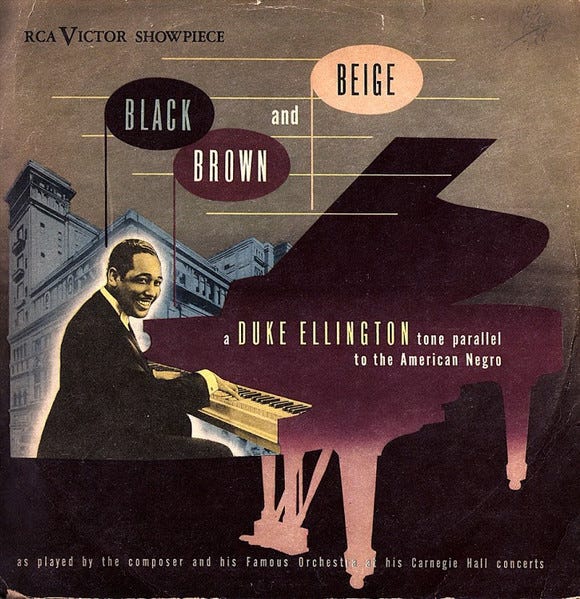
During his lifetime, Duke Ellington officially released two very different versions of Black, Brown, and Beige, on records, and neither was complete or definitive. There was the December 1944 recording for RCA, which included 18 minutes of the work, and the 1958 LP for Columbia Records, which featured Mahalia Jackson. Both of these are glorious in their own way, but they’re far from complete. Just the same, the 1944 recording was very well presented by RCA, in a rare example of a major label supporting a major jazz composer in a very important work, in a beautifully appointed 78 RPM album released in 1946. Although the tracks themselves have been reissued many times, I don’t think the artwork and notes have seen the light of day in decades, so I’m including them below as a kind of massive bonus track or “Lucky Strike Extra.”
DUKE ELLINGTON: JAZZ IMMORTAL
EDWARD KENNEDY ELLINGTON was born in Washington, D. C., in 1899. He rejected an art scholarship at Pratt Institute to play piano in several minor bands around Washington and, in 1923, came to New York with four other musicians and an idea that Gotham might be receptive to his music.
The Duke was correct. He opened at a little Broadway spot called the Kentucky Club, and soon the city’s jazz enthusiasts were spreading glowing word of his band. In 1927 he went into the Cotton Club in Harlem, then the city’s leading night club, and remained there for four years during which radio and record appearances gave his band a national reputation.
Great success followed quickly. Ziegfeld featured him in Show Girl, in which the Duke’s orchestra debuted a ballet to which Harriet Hoctor danced. With Maurice Chevalier he did a show on Broadway, and his orchestra toured the country in vaudeville, playing the Palace frequently and becoming the first Negro band to be engaged on the Texas Inter-State Circuit. And in Hollywood Ellington did several films, including Belle of the Nineties and Murder at the Vanities. In 1933 the band made a hugely successful European concert tour, repeating this triumphant procession again in 1939, just before World War II began.
The Duke returned to the Cotton Club, by then downtown on Broadway, in 1937-38, and continued his radio, vaudeville, and record work. In 1942 he wrote and appeared in the Negro hit musical revue, Jump for Joy, on the Pacific Coast, coming to New York in January ’43 for an historic twentieth anniversary concert in Carnegie Hall. This was Ellington’s debut in that auditorium and a wildly enthusiastic audience remained for three hours to cheer the Duke and his musicians.
All these years the Duke was writing the songs which have made his reputation as one of America’s foremost composers. They include: “Mood Indigo,” “Sophisticated Lady,” “Creole Rhapsody,” “I Got It Bad,” and three ASCAP song-of-the-year award winners, “Caravan,” “Solitude,” and “I Let a Song Go Out of My Heart.”
Ellington is married and has one son, Mercer, also a composer and now a member of the armed forces. Ellington’s sartorial habits still justify his high school appellation of “Duke,” but more important is his serious and thoughtful work on behalf of his fellow Negroes. This activity has made him a life member of the NAACP, and he was recently cited as one of the twelve most distinguished Negroes of the past decade.


BLACK BROWN and BEIGE
a Saga of the Negro in America as composed and played by DUKE ELLINGTON and his famous orchestra
BENEATH the surface of Duke Ellington’s busy life, as he travelled the length and breadth of this great nation to play for all manner of its people, stirred the restless rhythms of a new and insistent theme. It was conceived in the clicking wheels of innumerable trains. It was with him asleep or awake. It was before him as he watched the eager reception of his music from bandstand, stage, or concert hall and, as its swirling pattern took shape, it cried for expression until he was compelled to set it down.
For Duke Ellington had a story to tell—a poignant history of his people through three centuries of life in the new world. As truly as minstrels of old, he has traced the saga of a people who worked and fought, lived and died for liberty. He pictures them heavy with the work of America’s great industries, bent over the soil of America’s great yield, fighting to victory in America’s battles. He speaks of their deep religious fervor; he draws upon the wells of their sorrow, he presents them in the exuberance of their joy, in the simplicity of their philosophies. Here is the rich tradition, the soul, the mind, the hope of a freedom-loving people, in a musical translation which all America can understand.
As its title indicates, this most ambitious of all Ellington compositions was originally divided into three movements. At its premiere in Carnegie Hall (January 23, 1943), however, Ellington played a more abbreviated form, and it is these excerpts which the composer and his famous orchestra offer in the accompanying RCA Victor Records. Following is the Duke’s own interpretation of the music, as reported by Inez Cavanaugh.
WORK SONG
RCA Victor Record 28-0400-A
Work! Work! Work! That was the Negro’s introduction to America. Since 1619 he has heard the steady swinging of his ringing axe, the swish and slash of crop and brush, the sounds of busy hands. Silently he worked at first well; prodded by the slave-holder who knew him to be rebellious of his loss of freedom, he sang at his work, hugging to himself the hope that a better day would dawn for his race in this new land. So the work song was born ...
A song punctuated by the grunt
Of a heaving pick, a driving axe …
A song punctuated by the swish
And thud of a sledge hammer ...
A song to a mule ... an ox …
Fellow beasts of burden.
A song preceding the thrust
Of the foot that drove the shovel
Deep into the fallow, yielding earth …
A song accompanied by the lift and fall
Of the hoe …
A song sustained through the long tilt
And pull of the plow …
A song used as a weapon
To slash the ties of bondage!
(WF NOTE: I’m not sure what the above text is, either lyrics that have never been recorded or part of Duke’s written narration.)
In this work song, a “way back” figure has the heavy opening, leading into an heroic, robust, Harry Carney sequence. “The voice of a fighting man working like a diamond drill to work,” is the way Duke Ellington feels about it. Tricky Sam Nanton takes over with a homestead plaintiveness in his profound song, progressing firmly and steadily to the Otto Hardwicke spiritual which concludes on a moving tone. “That’s the way it should and ... must end,” says Ellington. “How can it be tied and boxed and stored away when there’s so much more to do? These unfinished endings are reality ...”
COME SUNDAY
RCA Victor Record 28-0401-A
Come Sunday and there is rest, there is peace. As the workers gather in the sun, the little white church with its glistening steeple seems to beckon them. They are filled with wonder and delight at the light shining through the stained glass windows. Breathlessly they listen to the wondrous sounds floating out to them. Now strangely soft and tender ... how unlike the harsh voice of everyday life.
Back Sunday feels from there, watching the church, drinking in the singing, the praising of God. The words are naked, muffled, but their meaning is clear. They find their own words as they hum along with the singing, weaving counter-melodies and rich harmonic patterns. So the spiritual is born ... the highly emotional worship-song of God in song.
Vividly descriptive, COME SUNDAY is introduced by Ray Nance’s pizzicato. Returning to his bow, he continues his solo as one of seven counter-melodies affecting a more and beautiful organ tone, the whole elevating the movement inside and outside of the church. The theme develops to the time when the workers have a church of their own and, in strong contrast, Johnny Hodges’ powerful alto saxophone sings. “We have no organ, no lovely white church with its steeple shining in the sun, but we are singing, and we do believe, and we shall keep on singing ... COME SUNDAY.”
THE BLUES
RCA Victor Record 28-0401-B
Duke Ellington places the inception of the BLUES at the end of the Spanish-American War, when the many Negro soldiers decorated for their heroism at San Juan Hill returned to their homes. As Ellington explains: “Where there are heroes there is glamour, and where there is glamour there is attraction to the opposite sex. Many soldiers returned to attract other men’s mates. Some returned to find their own women otherwise attracted ... it was the old story of the love triangle. In all love triangles there is the short side ... and he who loses and loves is on the short side ... with the Blues!”
Joya Sherrill’s meaningful vocal interpretation of Duke Ellington’s all-time answer to the perennial question “What is the Blues?” is highlighted by a magnificent tenor solo by Al Sears, singing a blues of his own on his saxophone in the true blue Indigo tradition. A trombone trio talking it over with the ensemble completes the side.
“The Blues …
The Blues ain’t …
The Blues ain’t nothin’ but a cold gray day.
And all night long it stays that way.
Ain’t comp’ny leaves you alone,
Ain’t nothin’ you want to call your own.
Ain’t comp’ny with sense enough to get up and go,
Ain’t nothin’ like nothin’ I know.
The Blues …
The Blues don’t …
The Blues don’t know nobody as a friend,
Ain’t been nowhere where they’re welcome back again …
Low ... ugly ... mean ... BLUES!
The Blues ain’t somp’n that you sing in rhyme,
The Blues ain’t nothin’ but a dark cloud markin’ time.
The Blues is a one-way ticket from your love to nowhere,
The Blues ain’t nothin’ but a black crepe veil ready-to-wear.
Sighin’ ... cryin’ …
Feel just like dyin’ …
The Blues ain’t …
The Blues ain’t nothin’ …
The Blues ...”
(WF NOTE: “The Blues” was sung at the 1943 Carnegie premiere by the very wonderful Betty Roché and then on the recording by the equally impressive Joya Sherrill. The only major jazz vocalist to include this number in his act on a regular basis was the late Mel Tormé, who sang it brilliantly on his classic 1956 album with the Marty Paich Dektette.)
THREE DANCES
RCA Victor Record 28-0400-B
Three exhilarating, exciting dances have been grouped in the typically brilliant Ellington finale.
1. WEST INDIAN DANCE—A dedication to the valorous deeds of the seven hundred free Haitians of the famed Fontages Legion, who came to aid the Americans at the siege of Savannah in the Revolutionary War. This dance boasts a melodic transitionless duet in the West Indian manner, which melts into the sax mixture and finally ascends to the ultimate in the primitive permutation of Taft Jordan and Tricky Sam. Ray Nance adds a few touches of his violin in rhumba rhythm.
2. EMANCIPATION CELEBRATION—The most complex of the Three Dances, this composition describes the advent of joyfulness on the part of the young people, and the bewilderment of the old at that “great gettin’ up mornin’.” Youth anxiously anticipated a lifetime of glorious freedom; for age, after long, weary years of servitude and a goal of rest and care, suddenly found itself intensely free to go—but where?
The total strain of this dance captures the spirit of youth’s “graceful awkwardness” and abandon, in the solos of Tricky Sam Nanton and Junior Raglin. In combination, they form a trumpet duet which reflects the despair and frustration of two old people who, with heavy hearts, hear the stark pronouncement “You are free to go!”
3. SUGAR HILL PENTHOUSE—This dance (also known as “Creamy Brown”) opens with a sixteen bar sequence by the four saxes, with Harry Carney’s creamy clarinet on top. Ellington describes it as “representative of the atmosphere of a Sugar Hill penthouse in Harlem, which cannot be understood nor appreciated unless one has lived there.” He slyly continues, “If you ever sat on a beautiful magnetic cloud overhanging New York City, you were on Sugar Hill.”
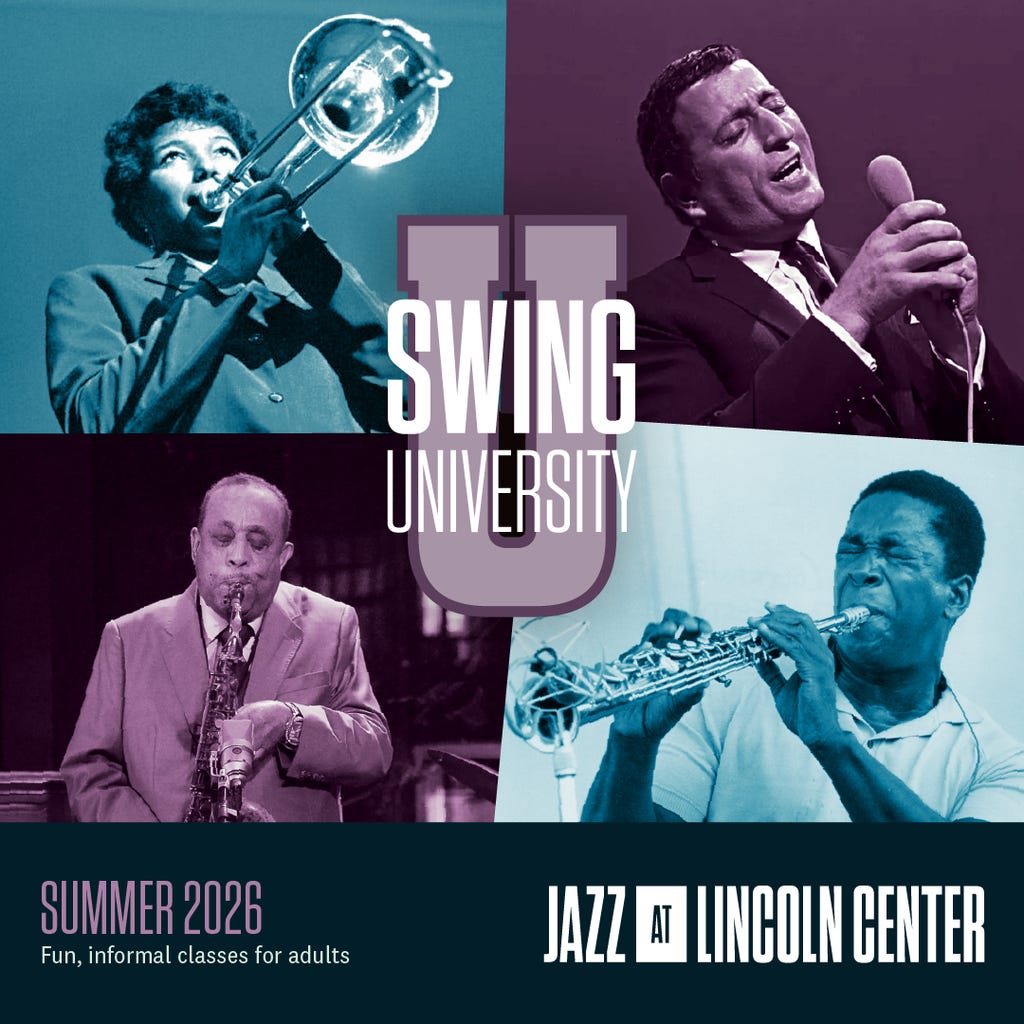
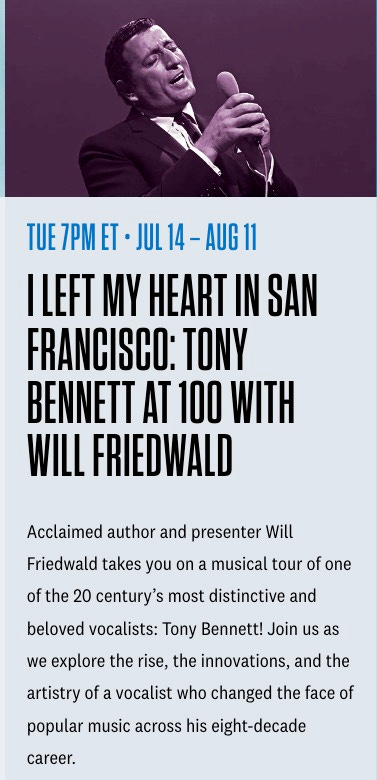
Over the next five Tuesdays, I am doing a comprehensive zoom series on the life and music of our favorite centennial celebrant, the legendary TONY BENNETT! To register (and it’s very reasonable) click Here:
Coming Next: Summer Time is Comedy Time
Jackie (Mason) and Me: In Honor of The Jackie Mason Musical, written by his longtime partner, Ginger Reiter, and starring his daughter, Sheba Mason, in a limited run in New York. At the Actor’s Temple Theater July 25-26. For Tickets and more info, click here.
Very special thanks to Elizabeth Zimmer, Rob Lester, & Dan Fortune for their expert proofing, hey!) Special Thanks again to Daniel Weinstein, Jordan Taylor, & Rob Waldman.)
Slouching Towards Birdland (Will Friedwald’s Substack) is a reader-supported publication. To receive new posts and support my work, consider becoming a free or paid subscriber.
Sing! Sing! Sing! : My tagline is, “Celebrating the great jazz—and jazz-adjacent—singers, as well as the composers, lyricists, arrangers, soloists, and sidemen who help to make them great.”
A production of KSDS heard Saturdays at 10:00 AM Pacific; 1:00 PM Eastern.
To listen to KSDS via the internet (current and recent shows are available for streaming) click here. Here is the running list of recent shows.
The whole series is also listenable on Podbean.com; click here.
SING! SING! SING!
Bastille Day! Jacques Brel (SSS #206 2026-07-18)
Listen: + Playlist:
Jazz Goes Broadway! West Side Story
(SSS #205 2026-07-11)
Listen: + Playlist:
Judy Garland sings Harold Arlen (SSS #203 2026-06-27)
Listen: + Playlist:
July 4th Special—Great American Cities in Song (SSS #204 2026-07-04)
Listen: + Playlist:
Miles Davis @ 100: Sketches of Broadway (2026-06-24)
Listen: + Playlist:
200th Episode Special! Friedwald’s Favorites & Wilsci’s Winners
(SSS #200 2026-06-06)
Listen: + Playlist:
Miles Davis @ 100 | “Miles Ahead”
(SSS #202 2026-05-30 )
Listen: + Playlist:
Bobby Darin @ 90 | “By Request”
(SSS #201 2026-05-23)
Listen: + Playlist:
Jazz at Lincoln Center Swing University:
A Special video Session: Sinatra in the Sixties (click to view)
With Seton Hawkins & Will Friedwald (Thursday April 2, 2026)
Bing Crosby Birthday Special—Ultimate Broadway Songbook
(SSS #199 2026-05-16)
Listen: + Playlist:
The Sacred Music of Duke Ellington—Then and Now
(SSS #198 2026-05-09)
Listen: + Playlist:
TONY BENNETT REMEMBERED ON NY1
a video interview with Stephanie Simon and Will Friedwald 2023-07-23
Click Here
Cinco de Mayo:
The Ernesto Lecuona (and Margarita Lecuona) Songbook
(SSS #197 2026-05-02)
Listen: + Playlist:
Ella Fitzgerald Sings the Jimmy Van Heusen, Sammy Cahn, Johnny Burke, & Jule Styne Songbook(s) (SSS #196 2026-04-25)
Listen: + Playlist:
SLOUCHING TOWARDS BIRDLAND is a Substack newsletter by Will Friedwald. The best way to support my work is with a paid subscription, for which I am asking either $5 a month or $50 per year. Thank you for considering. (Thanks as always to Arlen Schumer for special graphics.) Word up, peace out, go forth and sin no more! (And always remember: “A man is born, but he’s no good no how, without a song.”)
Note to friends: a lot of you respond to my Substack posts here directly to me via email. It’s actually a lot more beneficial to me if you go to the Substack web page and put your responses down as a “comment.” This helps me “drive traffic” and all that other social media stuff. If you look a tiny bit down from this text, you will see three buttons, one of which is “comment.” Just hit that one, hey. Thanks!
Slouching Towards Birdland (Will Friedwald’s Substack) is a reader-supported publication. To receive new posts and support my work, consider becoming a free or paid subscriber.
Duke's longform works are astounding, "B, B & B" in particular- he truly found common ground between jazz, gospel and classical music here.
After this story was first published, Sony reissued the album on CD with bonus tracks of additional material presumably cut from the original issue, and extended liner notes, as part of their reissuing of Duke's Columbia albums. Although I don't believe a full unedited version of it has ever been made yet...
Wow, David this is a great article. Ellington was a master.