
Sinatra Sources & Deep Cuts: “Mandalay (On the Road to Mandalay)” (Kipling-Speaks)
A Million Singers & Musicians Have Based Performances on Iconic Recordings by Sinatra, but Who were The Chairman's Own Direct Inspirations?

When Capitol Records released Come Fly with Me (recorded in October 1957 and issued in January 1958) in the United Kingdom, it created a tremendous uproar. Side One ends with “On the Road to Mandalay,” a rather irreverent swing version of Rudyard Kipling’s classic poem, “Mandalay.” Kipling’s daughter, Elsie (Kipling) Bambridge—who was also in charge of the great poet’s estate—thought it was a mite too irreverent. She led the charge against it, echoed by the culturally conservative British press of the time, which roundly condemned it. (A year later, when Nat King Cole, working with the same great arranger, Billy May, came up with an irreverent swing version of the classic “Habanera” aria from Carmen titled “Madrid,” the same thing happened—it was déjà vu all over again.)
As I put it in Sinatra! The Song Is You:
The masterpiece of Come Fly with Me, an adaptation of Rudyard Kipling’s “Mandalay,” resounds as Sinatra and May’s most outrageous piece of persuasive percussion. The track was likely inspired by a highly swinging 1939 arrangement of the Kipling poem by Jan Savitt and his Top Hatters, featuring the band’s supremely hip vocalist, George “Bon-Bon” Tunnell. While Tunnell sings, “Come you back, you swingin’ soldier,” Sinatra eventually amended the lyric to “Come you back, you mother soldier.” For decades, English Sinatraphiles regarded the track as a rarity because it was initially dropped from UK pressings due to Rudyard Kipling’s un-Kiplingly stodgy estate (this being only twenty years after the poet’s passing). “Kipling’s daughter had the nerve to ban that in England. How dare she!” Sinatra sarcastically complained at his June 1958 concert in Monte Carlo, “Of course, she drinks a little bit, so we’ll forgive her!”
Sinatra took special delight in performing “Mandalay” before an audience of mostly British descent in Melbourne, Australia, in 1959: “This particular song was written from the poem by Rudyard Kipling. Now it seems that we have done a rather different version of ‘Road to Mandalay,’ so that his family has objected, and anywhere in the British Empire it is not to be played on the record. So they took it off the long-playing record of Come Fly with Me and replaced it with ‘Chicago.’ But this is an unusual version of ‘Road to Mandalay’—it’s comedic, but it swings, it jumps. I think that Rudyard Kipling’s sister [sic] was chicken not to let us put it on the record.”
Taking another look at the recorded history of “Mandalay,” one major point becomes clear: Mrs. Bambridge was indeed overreacting, not least because there had been a long history of pop and jazz interpretations of what might have been her father’s most celebrated work. (Although, granted, perhaps few of these earlier swinging versions of “Mandalay” had actually been released in England.)
Rudyard Kipling (1865-1936) wrote the original poem in 1890, and it was included in one of those books of poetry that we all grew up with—and that I particularly loved—Kipling’s Barrack-Room Ballads and Other Verses (1892). Even bereft of music, the piece proved hugely popular and was already iconic by the turn of the 20th century.
In 1907, an Ohio-born composer with the improbable name of Oley Speaks set “Mandalay” to music. Perhaps even more improbably, this Anglo-American hybrid, re-titled “On the Road to Mandalay,” became one of the major hits of early Tin Pan Alley; supposedly, the sheet music quickly sold a million copies. There are early recordings by singers Earl Cartwright (see below) and Frank Croxton, the singer to whom Speaks dedicated the song. One interesting point is that most of the classical-style recordings of “Mandalay” are by baritones, which is surprising given that most male singers in the early phonograph era were tenors. The track by Cartwright is amazingly well-recorded for 1912. (Note that the Cartwright version doesn’t use the famous melody by Oley Speaks but a comparatively rarer musical setting composed by John Dyneley Prince, better known as a Professor Emeritus of East European Languages of Columbia University.)
Above are a few more classical interpretations; the best known of these is probably the 1935 reading by the hugely popular baritone Lawrence Tibbett, who not only shellacked it for Victor but sang it in one of his films. (Tibbett was a native Californian and his mock-Cockney accent is notable: “On the rewd to Man-da-lye / where the flying fishes ply.”) I’m also including a very early television performance from 1949 by the highly acclaimed Metropolitan Opera leading man, Leonard Warren.
The irreverent pop and swing versions began arriving in 1938 with the wackiest of them all: trombonist and gonzo vocalist Jerry Colonna. Colonna became famous on the Bob Hope radio, show equally for his bushy mustache and for his ability to hold notes to extreme, comic lengths—rather like a highly exaggerated human trombone. Colonna’s 1938 interpretation, accompanied by arranger Fud Livingston “and his Fuddy Bears,” is a kind of Kipling medley that also incorporates portions of “Boots” and “Gunga Din.”
Kay Kyser’s 1939 version isn’t as hip as it would have been if “The Ol’ Professor” had recorded it during the war, by which point his orchestra had evolved into something more akin to Goodman or Basie. In 1939, the sound was still more reminiscent of Sammy Kaye or Shep Fields. There are triple-tongue “tucka-tucka-tucka” trumpets galore (a la Hal Kemp), but there’s also attractive vocalizing by “Handsome” Harry Babbitt—a gifted crooner with a sense of humor who more than pulled his weight with the College of Musical Knowledge—along with “Gorgeous” Ginny Simms and “Sassy” Sully Mason.
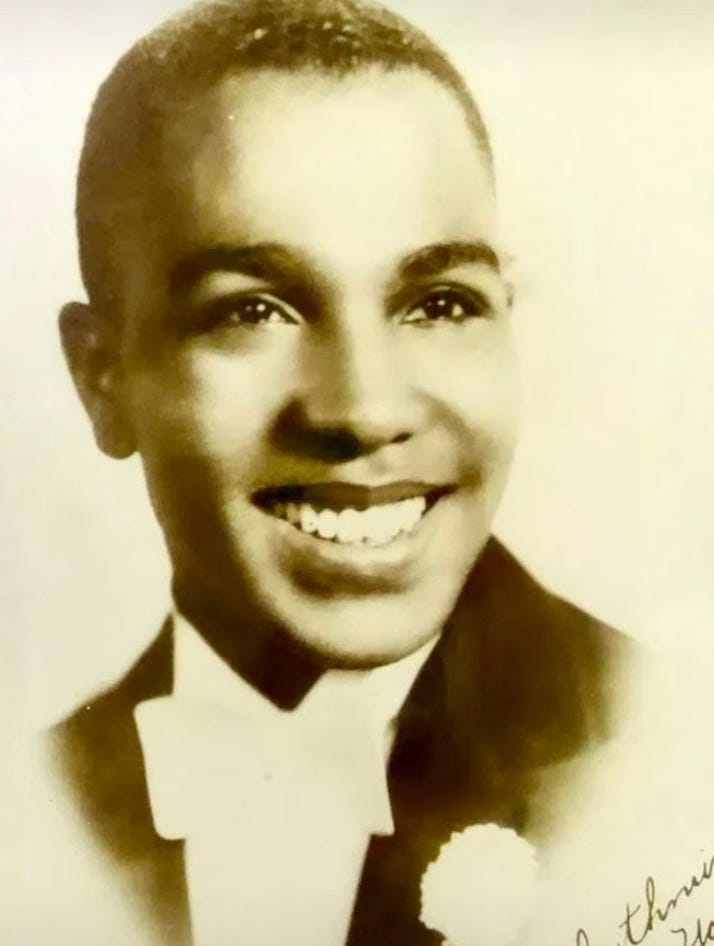
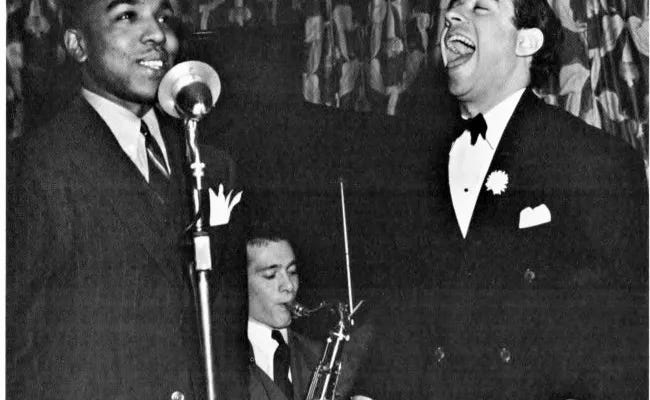
Which brings us to Jan Savitt and his Top Hatters with George “Bon Bon” Tunnell. Savitt was a former classical violinist from Philadelphia who led a very bouncy dance-and-swing band featuring the extraordinary vocals of the very hip African American singer billed as “Bon Bon” (George Tunnell, 1912-1975). Among others, Jon Hendricks testified to me more than once what a great and influential singer Mr. Tunnell had been. This version is much smoother and more swinging than any of the previous pop interpretations; though Bon Bon and the orchestra swing rather effortlessly, it’s neither a parody like Colonna nor a “Mickey Mouse” affair like Kyser.
This is a straight-ahead swing record in a solid 4/4, although, as our resident expert Daniel Weinstein reminds us, the arrangement is in the Savitt band’s signature “shuffle rhythm” style. Bon Bon clearly lays the foundation for Sinatra: “Come you back you swingin’ soldier—Come you back to Mandalay” directly prefigures Sinatra’s “Come you back you mother soldier,” as he often said in live performances of the song. Tunnell’s “can’t you hear the tom-toms beatin’” instead of “can’t you hear the paddles chunkin’?” also seems very proto-Frankish.
It’s a thoroughly delightful two-minute track, highlighted by a brief scat episode from the singer. The first time I heard it, I decided it had to be the template for the Come Fly with Me version, except that I later realized it is a Thesaurus radio transcription, meaning it was never commercially issued. Sinatra could certainly have heard it on the radio in 1939, but it is unlikely that he ever owned a copy, since it was never released on a 78.
The V-Disc version by Vaughan Monroe also shows that bands continued to swing “Mandalay” at least through the end of the big band era. The song possibly appealed to Monroe—he of the “mellow bellow”—in that he was also an almost ludicrously deep bass-baritone of the sort typically associated with the song.
As for Frankie Laine, he had a penchant for outdoorsy, “manly-man” type songs and recorded a number of titles that Sinatra would later get around to, like “Mandalay” and “Granada.” Unlike Sinatra, Laine includes the second verse (“’Er petticoat was yaller an’ ‘er little cap was green...”) whereas Bon Bon only includes the first verse. It is still my contention that Jan Savitt and Bon Bon offer the true precursor to Sinatra, but Sinatra undoubtedly also heard Frankie Laine. In fact, Laine’s exaggerated and highly dramatic big-note ending quite possibly provided Sinatra with the inspiration to do precisely the opposite: to eliminate the ending entirely so as not to be compared with Señor LoVecchio.
October 1, 1957 (Tuesday) – Hollywood. Capitol recording session No. E-36 – Capitol Tower (8:30 PM to 11:30 PM). Frank Sinatra with orchestra conducted by Billy May.
Mannie Klein, Conrad Gozzo, Shorty Sherock, Pete Candoli (trumpets);
Si Zentner, Murray McEachern, Tommy Pederson, Joe Howard (trombones);
Skeets Herfurt, Buddy Collette, Ted Nash, Jules Jacob, Fred Falensby (reeds / woodwinds); Verlye Mills (harp); Bill Miller (piano); Al Hendrickson (guitar); Joe Mondragon (bass); Joseph H. “Country” Washburne (tuba); Alvin Stoller (drums); Frank Flynn (percussion). (Info from Put Your Dreams Away: A Frank Sinatra Discography, compiled by Luiz Carlos do Nascimento Silva)
This is the classic Sinatra-Billy May treatment from Come Fly with Me, which is filled with hi-fi and stereo-type effects that, as Billy told me, were inspired by the Eddie Sauter-Bill Finegan Orchestra. May really leans into the mock-exotic Oriental effects—with flutes, woodblocks, and even some passages in march time—in an arrangement that’s as whimsical and irreverent as Sinatra’s actual singing. Surprisingly, there are only two percussionists listed: Alvin Stoller on trap drums and Frank Flynn playing vibes. The two of them were likely doubling and tripling on woodblocks, tympani (played with mallets), and at least one oversized Asian gong. (A few years later, as on the 1962 “Moonlight on the Ganges,” those percussion implements would have come from the collection of Emil Richards, but this was before Richards was a regular player on Sinatra’s team.) May also uses both a string bass (veteran West Coaster Joe Mondragon) and a brass bass (ie, a tuba), played by “Country” Washburne, better known for his tenure on tuba and occasional vocals with Ted Weems and his Orchestra.
As Daniel Weinstein adds, “Billy May’s arrangement digs deep into the Lunceford / Oliver style, especially the instrumental middle portion, where the melody is rendered in that clipped and precise accented style with which Lunceford played many erstwhile legato songs. As with Lunceford, the tempo of the Sinatra is much more laid back than the Savitt.” In that sense, this is another of the many Sinatra arrangements by both May and Riddle that owes a lot to Sy Oliver, although there are direct echoes of Tunnell’s vocal on the 1939 Savitt transcription.
Sinatra starts with the first verse (“By the old Moulmein Pagoda, lookin’ lazy at the sea”), and when he returns following May’s juicy instrumental break, he goes immediately to the sixth and final verse (“Ship me somewhere east of Suez, where the best is like the worst”). That phrase, “East of Suez,” had already inspired a famous modern jazz number by Charlie Ventura with Jackie Cain and Roy Kral. As noted, Sinatra ends with the lines, “On the road to Mandalay / Where the flyin’-fishes play / An’ the dawn comes up like thunder…” at which point the whole shebang (and the whole side, since this is the last track on side one of the LP) ends with a resonant gong.
Sinatra’s irreverence is the point: the song is written from the perspective of an old Cockney soldier reflecting on his lost loves and, more significantly, his lost youth. Kipling, like Bertolt Brecht after him (in numbers like “Cannon Song” and his own “Song of Mandalay”), is telling us that the indigenous peoples being suppressed are not the only victims of imperialism; so too are the young British soldiers who were unwittingly shipped halfway around the world and had their youth taken away from them, much like American troops in Vietnam. And as with Noël Coward in “Mad Dogs and Englishmen,” Kipling is condemning the British Empire more than celebrating it. As he writes in “Gentlemen Rankers” (which became, in a much-sanitized pop song rewrite, “The Whiffenpoof Song” and also inspired the title for James Jones’s From Here to Eternity), “God help us, for we knew the worst too young.”
(An additional note from Rob: most of the British pressings of Come Fly with Me that we have seen use “It Happened in Monterey,” recycled from Songs for Swingin’ Lovers, rather than “On the Road to Mandalay” or “Chicago” as the last track on Side A, and there are some that include the single “French Foreign Legion.”)
“Road to Mandalay” became a favorite of Sinatra’s for a few years, one of the songs from Come Fly with Me that he reprised occasionally in concerts. Perhaps the best live version is from the May 9, 1958, episode of Sinatra’s ABC-TV show. This is a singularly excellent half-hour that I dearly wish the Frank Sinatra Estate (FSE) would officially release on home video or share on youtube.com. For starters, the guest is Ella Fitzgerald—the first of three TV shows they would do together. The premise is that Sinatra wants to do an album with her (which would never happen, alas) and he nominates “Mandalay” as a candidate for the proposed project because, as he says, it’s got a lot of class—with a capital “K.” As the orchestra starts the distinctive intro to the song, you can hear Sinatra say to Fitzgerald, half under his breath, “Watch this mother!” (This being on vintage 1958 live television, an era well before the network censors had any idea that, as Billy Eckstine famously put it later, “‘Mother’ is only half a word.”)
Making the show even more thrilling, the soundstage is set up like a concert or a recording studio, with Sinatra in front of the orchestra, which is in plain view. It’s particularly satisfying to see Nelson Riddle conducting his colleague Billy May’s orchestration with this all-star ensemble and even an integrated crew; Buddy Collette on flute and reeds and bassist Joe Comfort are plainly visible. There’s also guitarist Al Viola and pianist Bill Miller. Sinatra’s body language is amazing—especially when he gives a telling shrug in rhythm to one of May’s Asian-style interjections. And Ella Fitzgerald puts the cherry on top when, after Sinatra concludes, she comes in with the hitherto unsung final line, “out of China, ‘cross the bay!”
We have one more vintage video performance of Sinatra doing “Mandalay,” this time live at the Sands in Las Vegas, as recorded and filmed by a crew hired by the singer himself. (The YouTube poster gives a date of November 5, 1961, but checking with Michael Kraus and Ed O’Brien reminds us that while Sinatra was indeed playing the Sands during that week, he came down with throat problems on that day and did not perform on November 5th.) In any case, he’s looser and more insouciant than ever—as in some of the concert versions, he refers to the “Egg Foo Young pagoda,” egged on by off-stage kibbitzing from Dean Martin and Joey Bishop.
Thanks as always to Team Slouching: Elizabeth Zimmer, Rob Lester, Dan Fortune, Daniel Weinstein, Nick Rossi, and Dan Levinson!
Our next virtual (online) presentation—for more info and to register, click here
WEDNESDAY, MARCH 18TH at 7:00PM EST.
Coming Very Soon—Your Next Favorite Substack: “The Adventures of Bill Boggs.” Yes! (Watch this space for details!)
(Very special thanks to Elizabeth Zimmer, Rob Lester, & Dan Fortune for their expert proofing, hey!) Special Thanks again to Daniel Weinstein, Jordan Taylor, & Rob Waldman.)
Sing! Sing! Sing! : My tagline is, “Celebrating the great jazz—and jazz-adjacent—singers, as well as the composers, lyricists, arrangers, soloists, and sidemen who help to make them great.”
A production of KSDS heard Saturdays at 10:00 AM Pacific; 1:00 PM Eastern.
To listen to KSDS via the internet (current and recent shows are available for streaming) click here. Here is the running list of recent shows.
The whole series is also listenable on Podbean.com; click here.
THIS JUST IN! THE OFFICIAL ALL-NEW
“SING! SING! SING!” T-SHIRT!

“IT’S TRUE!
IT’S TRUE!
IT’S ALL TRUE!”
SING! SING! SING!
The Irene Higginbotham Songbook (Women’s History Month)
{with special guest, Dr. Michael Garber, author Songs She Wrote}
(SSS #190 2026-03-14)
Listen: + Playlist:
The Irene Higginbotham Songbook (Women’s History Month)
{with special guest, Dr. Michael Garber, author Songs She Wrote}
(SSS #190 2026-03-14) SPECIAL BONUS MINI-EPISODE
Listen: + Playlist:
Channeling the Living | Black History Month | Pledge Week w Matt Silver
(SSS #188 2025-02-28)
Listen + Playlist
Big Band V-Discs with David J. Weiner
(SSS #187 2025-02-21)
Listen: + Playlist:
Four Bacharach-centric episodes of SING! SING! SING!
(And yes, the most recent of these focuses on the lyrics of BOB HILLIARD, with Burt Bacharach and other composers and songwriting partners!)
The Bob Hilliard Songbook—from Sinatra to Bacharach
(SSS #184 2025-01-31 )
Listen + Playlist
Going Bacharach, Part 3 (Strictly Instrumental)
(SSS #182 2025-01-17)
Download: <or> play online: + Playlist
Going Bacharach, Part 2
(SSS #181 2025-01-10)
download: <or> play online: + Playlist
Going Bacharach Pt 1: Bacharach Around the Clock
(SSS #023 2022-12-03)
download: <or> play online: + Playlist
Valentine’s Day with MELISSA ERRICO
(SSS #186 2025-02-14)
Show: + Playlist:
Ken Peplowski Meets the Master Singers
(SSS #185 2025-02-02)
Show: + Playlist:
The REBECCA KILGORE Memorial Show
(SSS #183 2025-01-24 )
download: <or> play online: + playlist
The Sammy Davis Jr Centennial - Sammy By Request
(SSS #177 2025-12-13)
download: <or> play online: + Playlist
Sinatra sings Burke & Van Heusen REDUX
(FS 2025 01 2025-12-01)
Download: <or> play online:
SLOUCHING TOWARDS BIRDLAND is a Substack newsletter by Will Friedwald. The best way to support my work is with a paid subscription, for which I am asking either $5 a month or $50 per year. Thank you for considering. (Thanks as always to Arlen Schumer for special graphics.) Word up, peace out, go forth and sin no more! (And always remember: “A man is born, but he’s no good no how, without a song.”)
Note to friends: a lot of you respond to my Substack posts here directly to me via email. It’s actually a lot more beneficial to me if you go to the Substack web page and put your responses down as a “comment.” This helps me “drive traffic” and all that other social media stuff. If you look a tiny bit down from this text, you will see three buttons, one of which is “comment.” Just hit that one, hey. Thanks!
Slouching Towards Birdland (Will Friedwald's Substack) is a reader-supported publication. To receive new posts and support my work, consider becoming a free or paid subscriber.
Great, thanks!
I have another recording from Las Vegas early ‘60s with Tony Moretti conducting. Frank introduces “Mandalay” by saying, “this is a request. . . . .from me!”